
Hover to interact
Front
Photos
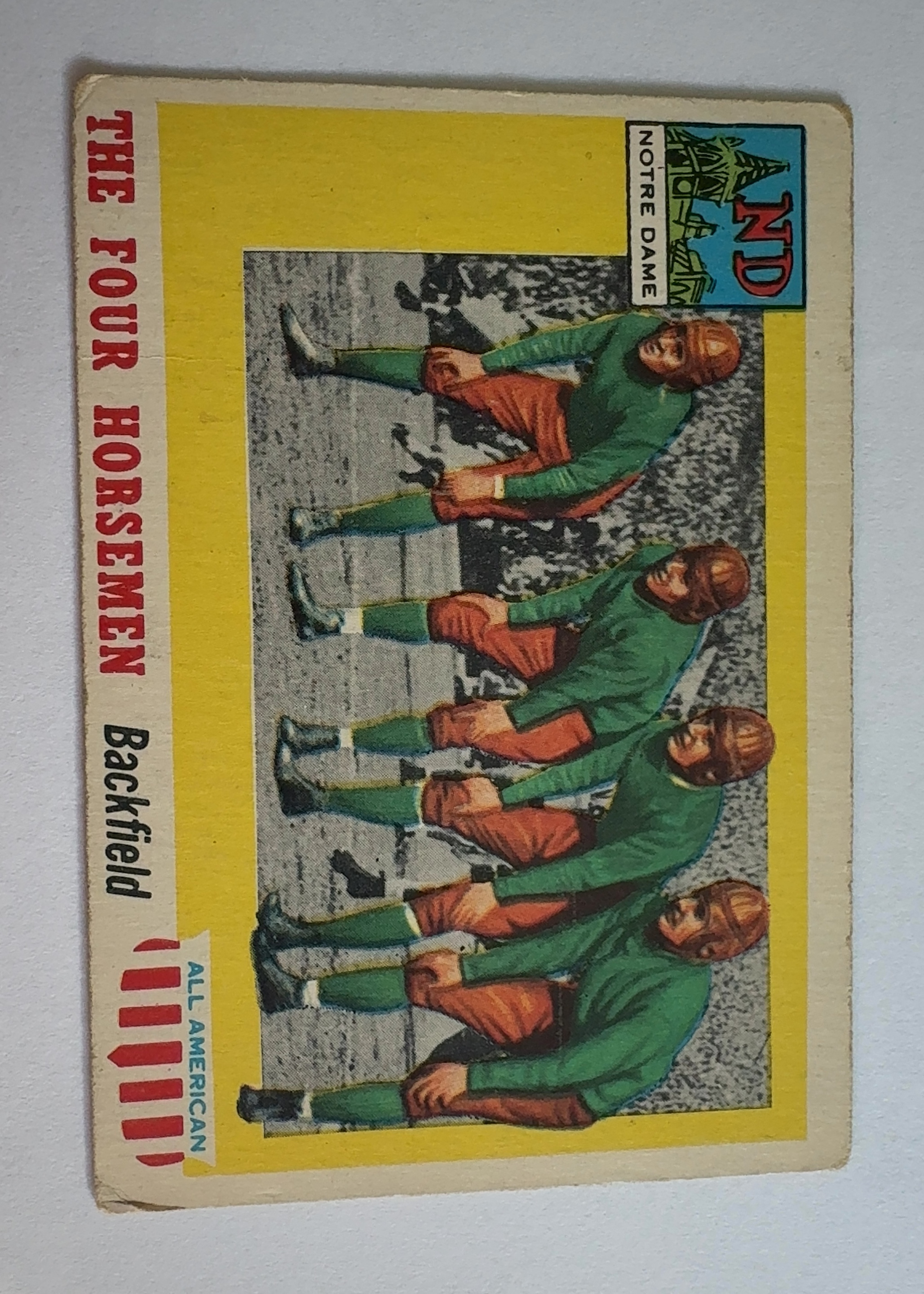
The Four Horsemen
Card Owner
Card Collector • Premium
Connect with collectors • Discuss cards • Build community
Card Information
Grade Breakdown
ResultsFront Side
Back Side
Analysis
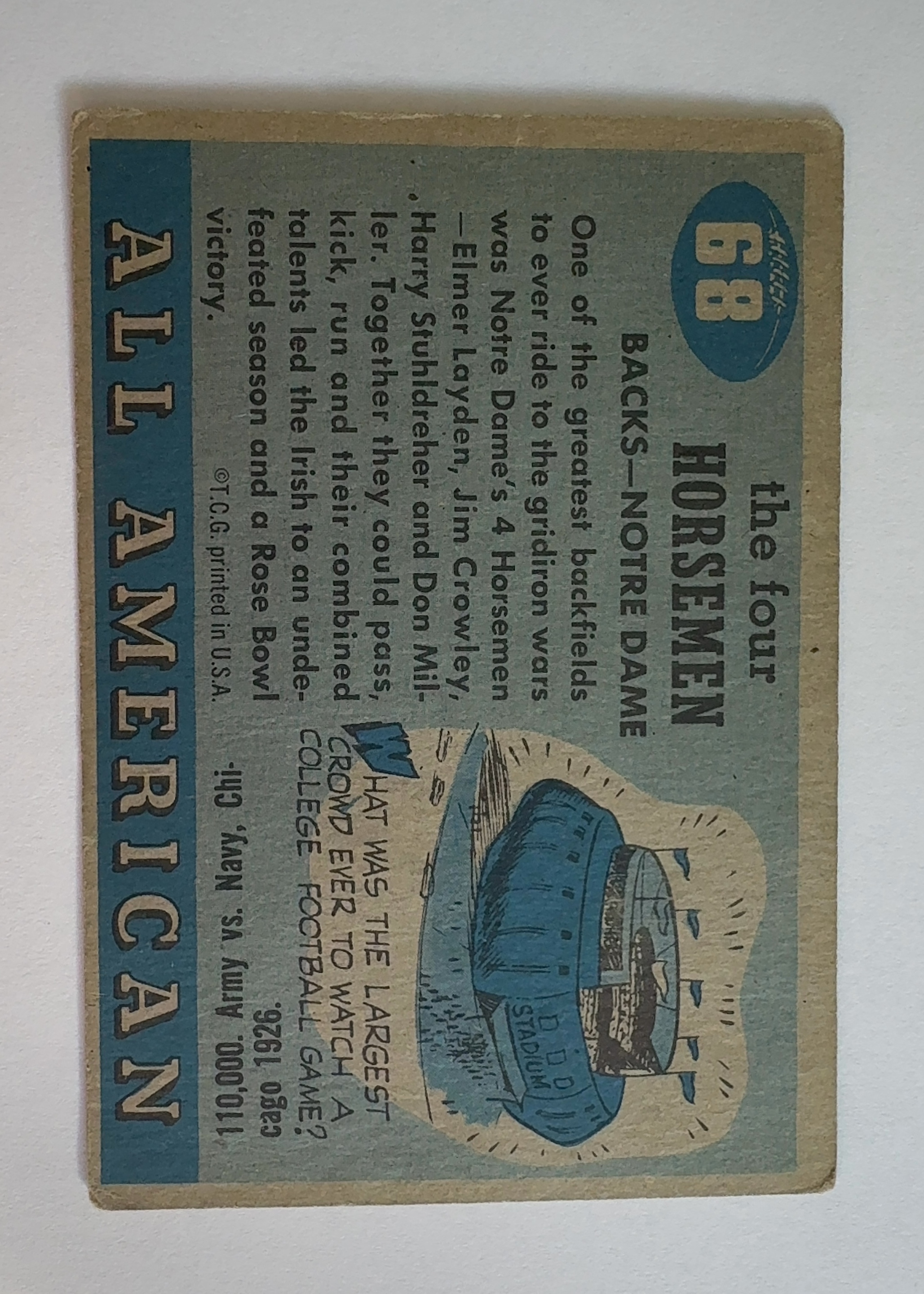
Locations refer to the card rotated so its text reads upright. Front: top-left D, rounded with exposed pale paper; top-right D, rounded and worn; bottom-left E, heavily rounded with diagonal creasing and disturbed paper; bottom-right E, crushed with visible separation of paper layers. Back: top-left D, rounded and abraded; top-right D, rounded with darkened exposed stock; bottom-left E, heavily worn with frayed paper; bottom-right D, rounded with broad abrasion. These are worn square-cut sports-card corners, not factory-rounded corners.
How this affects your grade:
Corners accounts for a significant portion of the overall grade. Improving this area could increase the overall grade.
Issues Found (6)
front lower border near FOUR, extending into the yellow field
A visible crease runs inward from the lower edge through the caption border and into the adjacent yellow area.
front bottom-left corner
Heavy rounding with compressed paper and diagonal corner creasing.
front bottom-right corner
Crushed, rounded corner with visible splitting or lifting of paper layers.
front top-left and top-right corners
Both original square points are worn away, leaving rounded curves with exposed stock.
back bottom-left corner
Heavy corner wear with frayed and disturbed paper.
back remaining corners and perimeter
Rounded corners and continuous handling wear, including pale chipping along the left edge.
Front Side
Back Side
Analysis
Front: top edge has small chips and uneven wear; bottom edge has extensive abrasion and damage near both corners; left and right edges show roughness and exposed stock. Back: all four edges are worn, with conspicuous pale chipping along the left edge and roughened bottom-edge sections.
How this affects your grade:
Edges accounts for a significant portion of the overall grade. Improving this area could increase the overall grade.
Issues Found (7)
front lower border near FOUR, extending into the yellow field
A visible crease runs inward from the lower edge through the caption border and into the adjacent yellow area.
front bottom-left corner
Heavy rounding with compressed paper and diagonal corner creasing.
front bottom-right corner
Crushed, rounded corner with visible splitting or lifting of paper layers.
front top-left and top-right corners
Both original square points are worn away, leaving rounded curves with exposed stock.
front perimeter
Widespread edge abrasion, small chips, and uneven exposed fibers.
back bottom-left corner
Heavy corner wear with frayed and disturbed paper.
back remaining corners and perimeter
Rounded corners and continuous handling wear, including pale chipping along the left edge.
Front Side
Back Side
Analysis
Front shows a visible crease extending upward from the bottom border near FOUR into the yellow field, additional corner creasing, scattered small marks, and aged border discoloration. Back shows toned stock, scattered dark specks, and light abrasion; no equally clear major central crease is visible.
How this affects your grade:
Surface accounts for a significant portion of the overall grade. Improving this area could increase the overall grade.
Issues Found (8)
front lower border near FOUR, extending into the yellow field
A visible crease runs inward from the lower edge through the caption border and into the adjacent yellow area.
front bottom-left corner
Heavy rounding with compressed paper and diagonal corner creasing.
front bottom-right corner
Crushed, rounded corner with visible splitting or lifting of paper layers.
front top-left and top-right corners
Both original square points are worn away, leaving rounded curves with exposed stock.
front perimeter
Widespread edge abrasion, small chips, and uneven exposed fibers.
back bottom-left corner
Heavy corner wear with frayed and disturbed paper.
back remaining corners and perimeter
Rounded corners and continuous handling wear, including pale chipping along the left edge.
back printed surface
Light abrasion and scattered small surface marks over the aged stock.
Front Side
Back Side
Analysis
Front appears approximately 55/45 to 60/40 left-right; top-bottom is approximately 60/40 after allowing for the intentionally larger caption area. Back is approximately 55/45 left-right and 60/40 top-bottom. These are visual estimates accounting for photographic perspective, not precise physical measurements.
How this affects your grade:
Centering accounts for a significant portion of the overall grade. This strong score contributes well to the final grade.
Front Side
Back Side
Analysis
Not applicable; this is a non-holographic card.
How this affects your grade:
Holographic accounts for a significant portion of the overall grade. Improving this area could increase the overall grade.
No grading history available